Showing posts with label science. Show all posts

Is it a bird? Is it a plane? No, it's a flying mobula ray

Posted by jai on Saturday, November 24, 2007


Lurking off Mexico's eastern shore in the Sea of Cortez, these flap-jack-like creatures burst out of the water with graceful precision.

Soaring as high as two metres above the plankton-rich green water, mobula rays are a sight to behold.

Here in the Sea of Cortez four species of mobulas (tarapacana, thurstoni, munkiana, and japanica) occupy the waters along with the giant manta ray.


read more about flying mobula ray.

Reflexology Map

Posted by jai on Friday, June 15, 2007


Reflexology, or zone therapy, is a complementary therapy, intended for use alongside conventional medical care and not as a replacement. It is the practice of stimulating nerves on the feet, hands and ears, in order to encourage a beneficial effect on some other parts of the body, or to try to improve general health. Reflexology is most commonly performed on the feet, moving on to the hands and/or ears where physical restraints (contraindications), such as veruccas or fractures, apply.
Via Reflexology

How to burn your cigarettes?

Posted by jai on Tuesday, May 29, 2007


Found via (Thanks): Cigarettesgadget

Best or worst of cigarette (I will not say good coz' nothing good on cigar, ), I personally did'nt like it's smell or smokes.. I will feel hard to breath! uhuk! uhuk!


Note: Good experiment.

Our sons don't need a father!

Posted by jai on Friday, May 18, 2007


Anna Lloyd and Jane Harvey could be any middle-class mothers strolling with their sons in their local park.

But behind their everyday appearance lies a story of a highly unconventional family - for they are lesbian partners, and Oliver and Charlie, aged two, are their twins.

While other boys might grow up kicking a football around with their daddy, this is something the twins, both the product of a course of IVF using an anonymous sperm donor, will never know.

Read more |family|

Orangutans attend 'jungle school' so they can be returned to safe forests

Posted by jai on Thursday, May 17, 2007


All pictures from : Daily Mail

Orphaned by hunters who hack their mothers to death, or victims of loggers destroying their forest, these wide-eyed, innocent orangutans have found a sanctuary to protect them.

And their unlikely new ‘mummy’? Former air-hostess Lone Droscher-Nielsen and her Borneo Orangutan Survival Foundation.

She has dedicated her life to saving orangutans whose habitat is being razed by bulldozers - without her, it is unlikely that any of these babies would be alive today.

Now they attend ‘jungle school’ so they can be returned to safe forests.

Read more: Orang Utan

The lamb dressed in panda's clothing

Posted by jai on Wednesday, May 16, 2007

You've heard of mutton dressed as lamb - but here's lamb dressed as panda.

The astonishing black-eyed markings on the youngster made it top of the flock as it gambolled with its newborn playmates.

Via: Panda Lamb

First Live Giant Squid Photographed

Posted by jai on Monday, May 14, 2007


This extraordinary image, captured by Japanese scientists, marks the first-ever record of a live giant squid in the wild. The mysterious deep-sea creature has inspired countless sea monster tales and a variety of scientific expeditions.


The giant squid was photographed 2,950 feet (900 meters) beneath the North Pacific Ocean in Japanese waters, where scientists attracted it toward cameras on a baited fishing line.

Many giant squid have washed up on beaches or have been found dead or dying in fishing nets. This specimen was found in New Zealand in 1996.

Related news:


Read more, found via : National Geographic | Photos

BROCCOLI Romanesco

Posted by jai on Tuesday, May 08, 2007

Romanesco Broccoli Head displaying it's mosaic pattern. The heads can grow as large as a medium sized cauliflower head, about twenty to twenty five centimetres across.

Via: Urban Food Garden
Found via: Neatorama

What You Know About Math??

Posted by jai on Monday, April 30, 2007


What you know about math, by TI-84 Ft.

hey, great video, really funny but are you supposed to look like complete geeks? i think you are but if you're not, untuck the shirts, undo top button, and pull the trousers down a little little bit.

Eyes Blinking

Posted by jai on Friday, January 12, 2007


(Images from google images, click picture to original web)


The average person's eyes will be closed about 30 minutes a day due to blinking.


| link |

Lemon Battery - DIY

Posted by jai on Saturday, November 18, 2006

Creating a battery from a lemon is a common project in many science text books. Successfully creating one of these devices is not easy.

Batteries consist of two different metals suspended in an acidic solution. Copper and Zinc work well as the metals and the citric acid content of a lemon will provide the acidic solution.
Batteries like this will not be able to run a motor or energize most light bulbs. It is possible to produce a dim glow from an LED.
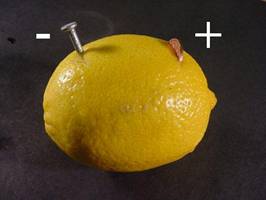
The picture at the top of this page shows a basic lemon battery, a lemon, copper penny and zinc coated nail.
The lemon: A large, fresh, "juicy" lemon works best.
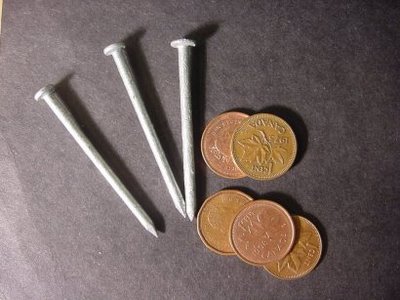
The nail : Galvanized nails are coated in zinc. I used a 2" galvanized common nail.
The penny: Any copper coin will work. (Canadian pennies from 1960 - 2001 all worked)
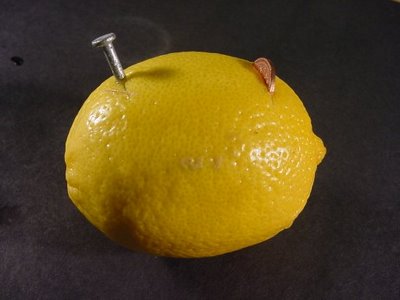
Creating the battery : Insert a penny into a cut on one side of the lemon. Push a galvanized nail into the other side of the lemon. The nail and penny must not touch.
This is a single cell of a battery. The zinc nail and the copper penny are called electrodes. The lemon juice is called electrolyte.
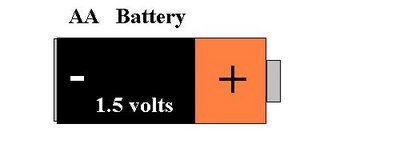
All batteries have a " +" and "-" terminal. Electric current is a flow of atomic particles called electrons. Certain materials , called conductors, allow electrons to flow through them. Most metals (copper, iron) are good conductors of electricity. Electrons will flow from the "-" electrode of a battery, through a conductor, towards the "+" electrode of a battery. Volts (voltage) is a measure of the force moving the electrons. (High voltage is dangerous!)

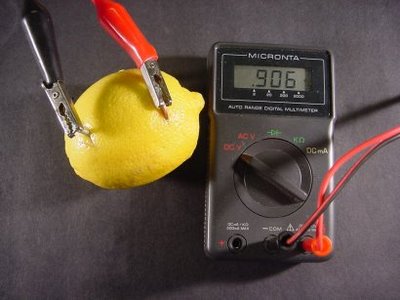
I have connected a volt meter to our single cell lemon battery. The meter tells us this lemon battery is creating a voltage of 0.906 volts.
Unfortunately this battery will not produce enough current (flowing electrons) to light a bulb.


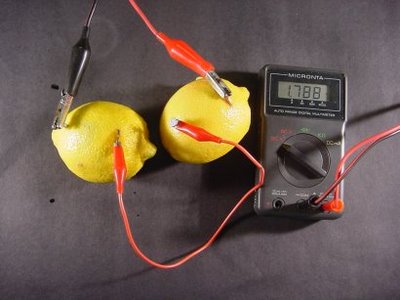
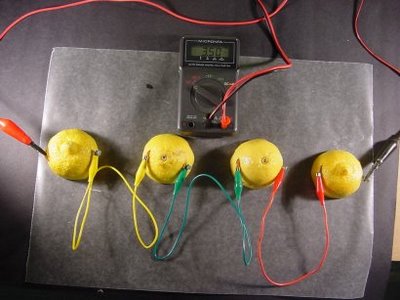
To solve this problem we can combine battery cells to create higher voltages. Building more lemon batteries and connecting them with a metal wire from "+" to "-" adds the voltage from each cell.
The two lemon batteries above, combine to produce a voltage of 1.788 volts. This combination still does not create enough current to light a small bulb. Note the red wire connecting the batteries is joined from "+" (penny) to "-" (galvanized nail).

Four lemon batteries create a voltage of 3.50 volts. We should be able to light up a small device like an LED (Light Emitting Diode).
Note the connecting wires go from "+" to "-" on each battery.

LED
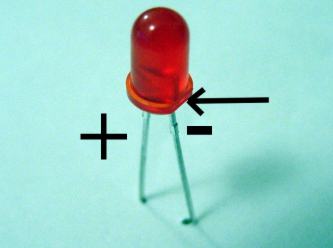
To turn on an LED you must determine the "+" and "-" connections. If you look closely at the red plastic base of an LED you will notice a "flat" spot (indicated by arrow above). The wire that comes out beside the flat spot must connect to the "-" side of a battery, the other wire to the "+" side.

Important information about LEDs : LEDs are designed to work at very low voltages (~ 2V) and low currents. They will be damaged if connected to batteries rated at over 2 volts. LEDs require resistors to control current when used with batteries rated at over 2 volts. Lemon batteries produce low current. It is OK to connect an LED to a lemon battery.
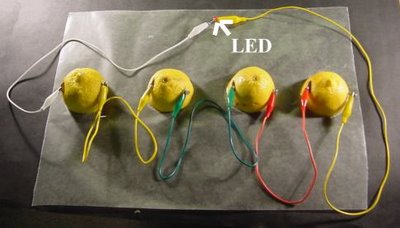

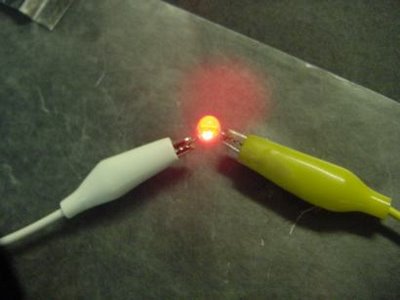
In the above image, electrons flow from the "-" (nail) end of our lemon battery through the LED (making it glow) then back to the "+" (penny) end of the battery. This is an electronic circuit. The LED glows dimly with this configuration.
Improving your battery.
The quality of the copper and zinc can be a problem for a battery like this. Pennies in particular are rarely pure copper.
Try substituting a length of 14 gauge copper wire (common house wire) for the penny. Experiment with different lengths and configurations of electrodes. Other sources of zinc and copper may be found in the plumbing supply department of a hardware store.

The first battery was created in 1799 by Alessandro Volta . Today batteries provide the power for an amazing variety of devices, everything from flashlights to robots, computers, satellites and cars. Inventors and researchers continue to improve the battery, designing batteries that last longer and that are more friendly to our environment.
Understanding how batteries actually work requires a knowledge of chemistry. The most important factor in battery design is the electrical relationship between the two metals used in the battery. Some metals give electrons away while other metals accept extra electrons. Chemists have investigated metals and created an "electric potential" table comparing different metals.